Stop doing sit-ups: I'm a personal trainer, and this single move targets your deep core better than 100 reps
Sit-ups and Russian twists still feature in many core workouts because they're known to target your abs and obliques, muscle groups that help create the rippling muscle definition you can see, alongside a low body fat percentage.
However, low back pain is common when performing these moves, whether due to a lack of core engagement, form, injury, or body mechanics. In other words, they're not for everyone, and that's okay, because there are plenty more fish (or abs exercises) in the sea.
If you're looking for some of the best low-impact exercises for your spine, I can help. You'll want to focus on strengthening your core as a whole, especially your deep core muscles, which are responsible for stability — and placing your body in positions that won't aggravate your back.
Here's what to do, from me (a personal trainer) to you.
If you are currently working with pain, an injury, or any health condition, I advise speaking with a qualified medical professional before starting any new exercises or workout programs. I'm not a qualified physical therapist and cannot diagnose a health condition.
How to do plank knee tucks
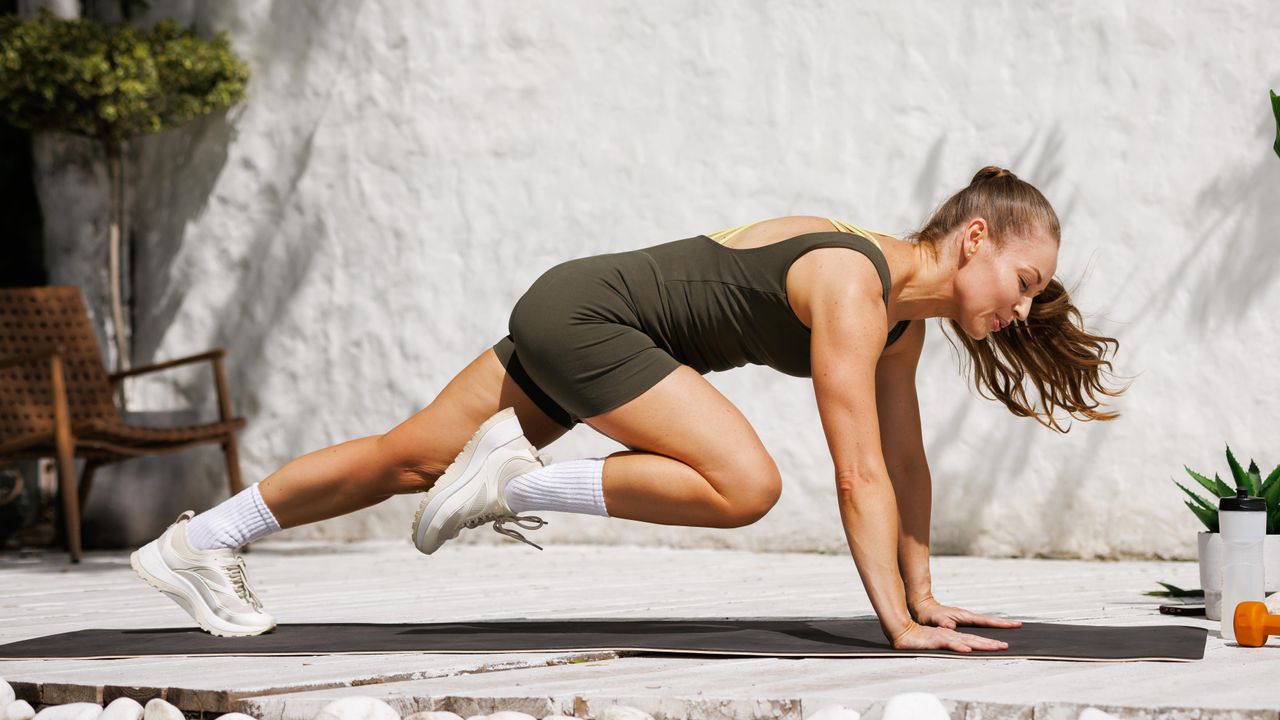
Plank knee tucks look a bit like mountain climbers, except you'll hold the position instead of moving your knees forward and backward.
This is about switching on as many muscles as possible to help you defy gravity and resist rotation, as you draw your knee high and forward toward your chest while pushing through your hands and doming your upper back.
It doesn't take long to feel the burn, and I love this exercise for its simplicity.
It doesn't take long to feel the burn, and I love this exercise for its simplicity.
You'll find many yoga and Pilates teachers using variations of this exercise, but it's been around in the fitness industry in its many forms for a long, long time.
It targets the aforementioned "deep core" by engaging muscles like the internal obliques and transverse abdominis; to a degree, your quads and hip flexors are also working as you hold your bent knee in the air, along with your arms, shoulders, chest, glutes, rectus abdominis (abs) and external obliques.
In other words, there aren't many places you won't feel it. To ramp up this move further, try looping one of the best resistance bands just above your knees to add more tension.
Here's how:
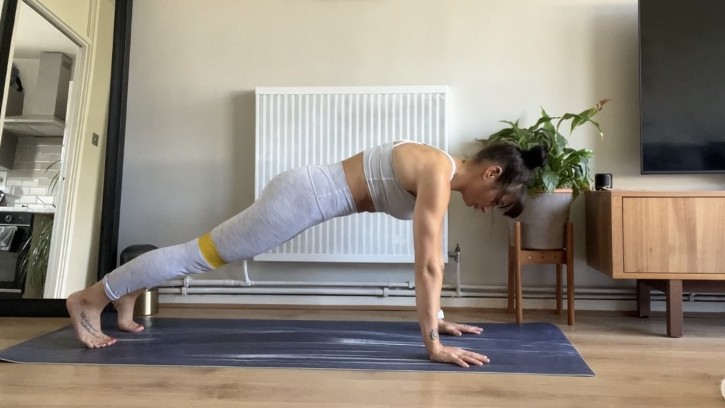
- Start in a plank position with your shoulders stacked over your wrists. You can also perform this in a forearm plank, but you'll have less space to work with
- Brace your stomach and pull your navel in. Ensure your hips align with your shoulders
- Push through your hands to slightly dome through your upper back, then draw your right knee forward between your hands
- Try to lift your knee high into your chest and point your toes. Hold for 10-20 seconds
- Return to plank, then switch sides
- Aim for 3-5 rounds of 10-20-second efforts.
Benefits
Here are some benefits of trying this exercise
Lower impact on your back
Low-impact core exercises help protect your spine by supporting your back. I'm not saying this means it's suitable for you, as only you and your physician can determine what works for your body, but for many people, the plank position is less stressful than moves like sit-ups or twists, where you're repeatedly rotating, flexing, or extending the spine.
It's very important to consciously contract your entire body and breathe into your stomach.
Cue: Focus on pushing up through your hands to create more space under your body; this will allow you to get a higher knee drive and generate more tension.
Strengthens your deep core
Your core (namely, the diaphragm, transverse abdominis and internal obliques) works to help you hold the position while maintaining your breath, called isometric muscle contraction. While, naturally, you will feel this in your hip flexors, try not to let it take away from your midsection.
Cue: Brace your stomach as if you're anticipating being punched there. Simultaneously draw your navel in and breathe down.
Translates to other exercises
You might not find yourself in a plank position daily, but this type of exercise is great for other activities like running or sprinting (think of the knee drive position as you lift your leg), hurdling, performing high knees, climbing, step-ups, hiking, walking and a multitude of other sports or hobbies you may not have considered.
What's more, building deep core strength and stability will also make you stronger and more injury-resistant.
Cue: See if you can add pulses or try adding touch points with your knee. First, try to touch your left wrist with either your left or right knee, then your right wrist, then move to each elbow, then toward the armpits.
What happened when I added it to my weekly routine?
I find plank knee tucks help me re-engage my core muscles because there is no getting away from the tension you create.
I didn't exactly take this on as an experiment, as it already features weekly in my yoga and Pilates classes; however, it has been cropping up a lot more recently, and I've been programming it more often for clients, too. So, here's why I love it.
I find plank knee tucks help me re-engage my core muscles because there is no getting away from the tension you create when you hold this position. It also tests my breathing, which I (and many of us) lose when we are in a stress position.
You can also keep increasing the time spent holding, starting with as little as five to 10 seconds and slowly adding seconds. It's simple and can be scaled to your ability, and if it ever feels too much, you could practice from a tabletop or forearm position instead.
I like that it makes me feel present with my body and mindful of what it's trying to do; I'm not rushing through reps but focusing on creating and holding positions, which I get a lot more out of than mindlessly moving through sit-ups, especially.
I like adding pulses to work my core a little harder, or moving my knee to tap different parts of my arms. Play around with it and have some fun, but never neglect your breathing.
Follow Tom's Guide fitness on Instagram for more workouts, routines, tips, and tricks.
More from Tom's Guide
- Not sit-ups, planks, or crunches: I do this simple Pilates exercise every single day to build a strong and stable core and work on my hip flexor mobility
- I'm a personal trainer: If you want to boost longevity after 40, these are the 5 exercises you should start with in the gym
- Move over lunges — I teach weightlifting, and this is the strength exercise I'd use instead
This is a preview from the original publisher. Continue reading at the source:
Read Full Article on tomsguide.com →