

AIO coolers are now so powerful that they need a built-in tiny PC for color monitors bigger than the iPhone SE
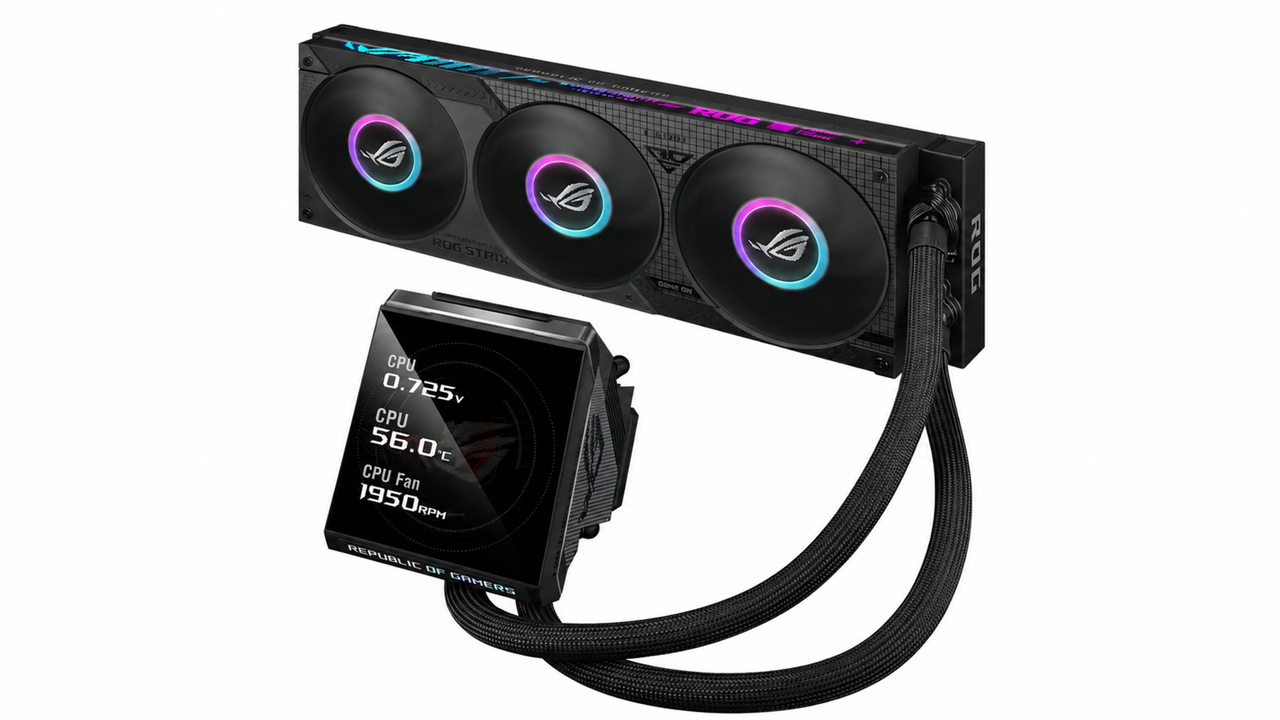
- Modern AIO coolers now contain hardware resembling miniature computers
- Large displays are becoming common features in premium liquid coolers
- MCUs now power advanced features inside modern cooling systems
Modern all-in-one (AIO) liquid coolers are increasingly resembling miniature computing platforms rather than simple hardware designed to move heat away from processors.
Several newly announced models now incorporate color displays approaching smartphone dimensions, complete with monitoring software, animations, and multimedia capabilities.
In some cases, the screens attached to CPU cooling systems are larger than the 4.7-inch display found on Apple's iPhone SE.
Tiny computers are now embedded inside cooling hardware
An example comes from ASUS, whose ROG Strix SLC IV incorporates a detachable 6.67-inch curved AMOLED display running at 2400 × 1080 resolution.
The company also offers the ROG Strix LC IV with a smaller 3.5-inch IPS panel, though both products retain extensive customization features.
Driving these displays requires considerably more than a simple temperature sensor because the screens must process graphics, animations, telemetry information, and user inputs.
Behind such displays sits a microcontroller, commonly called an MCU, which is effectively a complete computer integrated onto a single chip.
An MCU has its own processor, memory, storage resources, and input output functions, allowing it to operate independently within larger devices.
Twenty years ago, a high-end CPU cooler was little more than a large metal heatsink paired with one or two fans.
Modern flagship AIOs increasingly incorporate MCUs, wireless connectivity, high-resolution displays, RGB controllers, dedicated software ecosystems, and even video playback capabilities.
The result is an entertaining rise in complexity, with display-equipped coolers now relying on tiny computers to manage their advanced features.
As functionality expands, prices have also climbed, turning what was once a relatively straightforward component into one of the most feature-laden devices inside a modern PC.
This trend extends beyond ASUS as manufacturers increasingly compete through aesthetics rather than solely emphasizing thermal performance improvements.
JONSBO's TM-280 includes a 3.95-inch IPS screen capable of displaying hardware statistics, animated GIF files, images, and MP4 video playback.
Meanwhile, ASRock's Challenger Digital models integrate 3-inch LCD panels displaying processor temperatures, clock speeds, and pump operating information.
Antec has moved even further with the Vortex View 360, featuring a rotatable 5-inch IPS display operating at 1280 × 720 resolution.
Cooling performance now shares space with entertainment features
Manufacturers still improve thermal hardware through faster pumps, larger radiators, enhanced fan designs, and supplementary motherboard cooling solutions.
ASUS incorporates a small VRM cooling fan, while JONSBO rates its TM-280 for processors reaching thermal loads of 285W TDP.
Yet the most visible developments increasingly involve screens, lighting effects, wireless connectivity, software ecosystems, and display customization capabilities.
MSI recently introduced a fabric-covered cooler concealing a display beneath its exterior, illustrating how appearance has become increasingly influential.
Several of these products now depend upon dedicated software suites, internal USB connections, specialized controller hubs, and proprietary communication interfaces.
The ASUS wireless display implementation even relies upon a motherboard connection system carrying power, control signals, and data through dedicated contacts.
The evolution remains entertaining because these cooling components have transformed into feature-rich hardware that can justify higher prices for enthusiasts building showcase systems.
Some users, however, may question whether such additions are necessary for hardware whose primary purpose remains cooling a processor.
Via The Guru of 3D

This is a preview from the original publisher. Continue reading at the source:
Read Full Article on techradar.com →