

I'm a personal trainer who works with clients over 50 — these are the 3 mobility exercises I never skip

I'd call mobility training my happy place; my bread and butter. It's what makes me really smile because I see it make an enormous difference in people's lives, whether that's because they love exercise and want to continue doing it, or they just want to stay strong, balanced and mobile later in life.
Mobility is an entity unto itself, and if you don't enjoy it much, the good news is that microdosing your routine can still provide real benefits for strength, control and stability. In other words, even exercise snacking with 5, 10, or 15-minute routines can still give you results, as long as you're consistent and intentional.
Think of the three moves below as your anti-aging weapons for helping unstick your hips, lubricate your joints and get you moving more freely. They're low-impact exercises and can be made more beginner-friendly or challenging, and you can work with your bodyweight or with weights.
Below, I share my ride-and-die three moves I never skip with clients. Here's why.
Watch: 3 exercises you can try for better mobility anywhere
Do you know what "mobility" truly means? It sounds age-related, I think, but actually, there's a real focus on longevity, mindful movement, yoga and Pilates right now, which all feed into the mobility world.
Improving mobility isn't just about being able to put one foot in front of the other without straining something, or getting up off the couch to make a drink, although, yes, that absolutely matters.
It's about being intentionally dynamic by moving the joints through their range of motion in a variety of patterns, alongside strengthening and loading muscles using resistance. Think strength, control and motion without age-related limitation. A quick example is performing shoulder rolls and similar exercises before an upper-body workout.
The more you get your body moving throughout the day, the more you train yourself to balance and stabilize; the more you load your bones and muscles to maintain strength rather than atrophying or losing density.
Your joints, ligaments and fascia (in particular) respond well to low-impact movement, which can be achieved through a challenging yet consistent mobility routine.
If you experience pain at any time, stop and rest. If you're working with an injury or health condition, or you're currently pregnant or postnatal, I recommend seeking advice before starting these exercises.
The routine: 3-4 sets, 8-10 reps per move. For more of a mobility flow, try 60 seconds per move for a few rounds.
You pay for annual membership rather than an upfront cost at Whoop. There are three price tiers: One is $199/£169 per year, Peak is $239/£229 and Life is $359/£349 per year. This deal gets you Peak for less than the cost of One.View Deal
- Overhead squat to block: Stand with your feet wider than shoulder-width apart with a block positioned on a setting suitable for you (I use high) behind you. Raise your arms into the air, holding a weight if you want to, and engage your core. Sit your hips back and lower into a squat, keeping your feet planted, back straight and chest lifted. Try to avoid letting your arms travel forward. Touch the block with your butt, then drive up through your legs to stand.
- Single-leg hip circles: In a tabletop position, stack your wrists under your shoulders and knees under your hips. Draw your stomach in and press through your hands to create space. For an extra challenge, place a dumbbell or similar on the right. With control, lift your right leg, keep the knee bent and circle the leg around the dumbbell, changing direction every rep. Remember to switch over to your left side. Aim to keep both hands pressed down; raise your hands onto blocks or come onto your fingertips if needed.
- Leg liftovers: Sit with your back straight and legs extended wide. You can rest your back against a wall or couch for extra support. Sit tall through your spine and place your hands lightly behind your head, drawing your elbows back. Position a dumbbell or similar to the right of your right leg. Practice lifting your leg up and over the dumbbell in both directions. Remember to switch to the other side. Play with height settings depending on your ability.
What are the benefits?
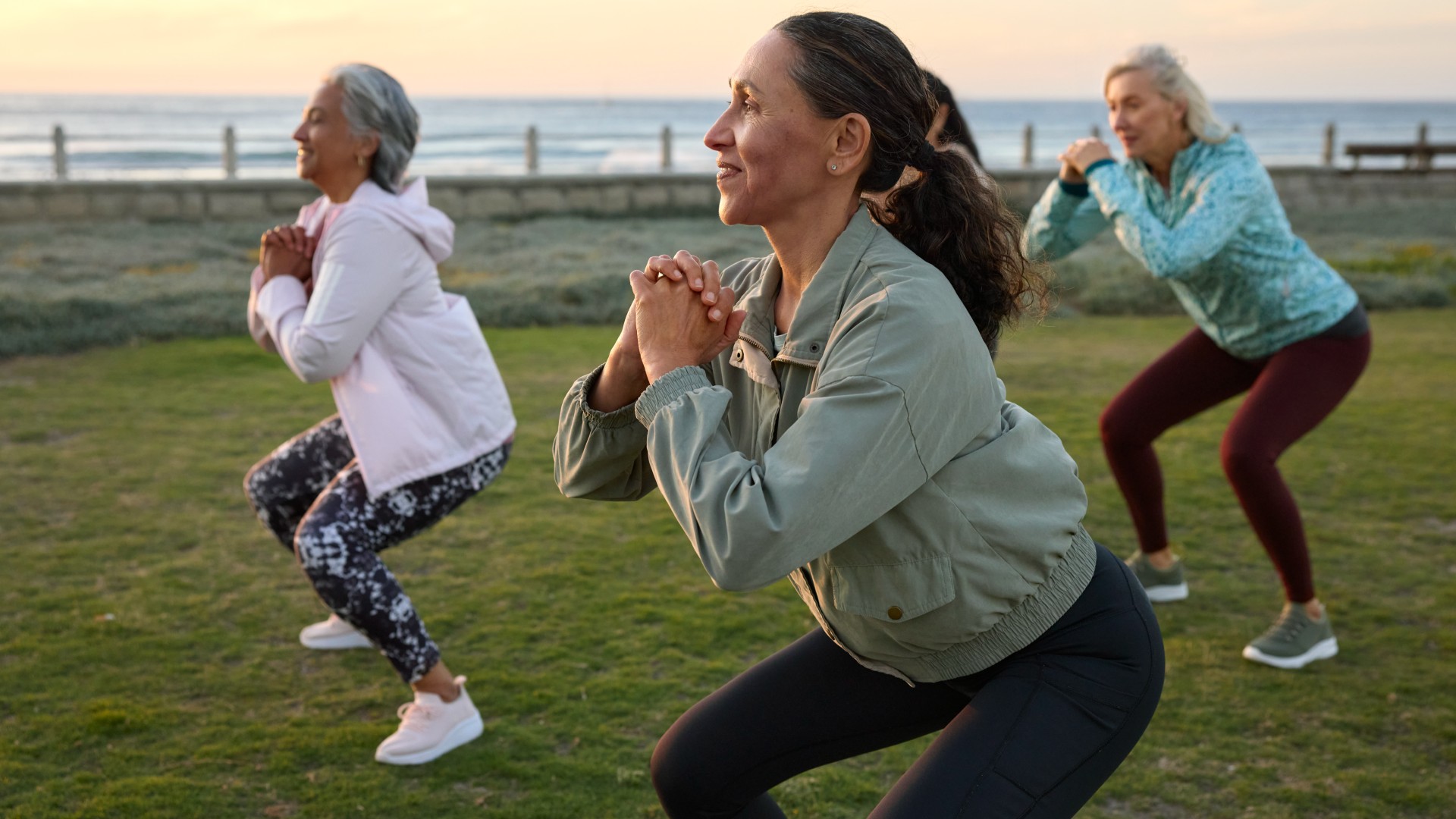
I use these moves all the time with clients. Depending on their ability, programs and individual preferences, we mix them up to add weights, bands, or reps and sets, or we might try variations on the above to keep things interesting.
Here are some benefits:
Overhead squat to block: Squatting improves lower-body strength, but your ability to squat low will depend on a mix of thoracic, hip, knee and ankle mobility. This exercise allows you to practice using one of the toughest squat variations (the overhead squat) for engaging the upper body and shoulders. This will test, and hopefully improve, your ability to keep your chest lifted and shoulders back as you sit the hips back and try to reach the block with your butt.
Single-leg hip circles: This is one of my favorite exercises to give my dad for his stiff hips. You don't have to use a dumbbell, but having an object to circle will keep you accountable; don't worry how many times you knock it over, as that's part of the fun. Aim to create large circles in both directions, which makes space around the pelvis and warms the muscles and joints of the lower body.
Leg lift-overs: These are killer on hip flexors that run along the front of your hips, plus the thighs, core and upper body. Focus on knitting your shoulder blades together and sit tall to help engage your upper back and open your chest. As soon as you start hunching, you're losing form, so be mindful and use a wall for support if needed. Again, the dumbbell is optional but helpful.
If you have tight hamstrings, I recommend sitting on the edge of a book or yoga brick to help tilt the pelvis and take some pressure off. An extra challenge would include looping a resistance band just above your knees.
I use these moves all the time with clients. Depending on their ability, programs and individual preferences, we mix them up to add weights, bands, or reps and sets, or we might try variations on the above to keep things interesting.
Before you consider adding weight in the form of kettlebells, dumbbells, or even water bottles, focus on the fullest range of movement you can during every rep. For example, I would never add weight to a squat until my client can reach adequate squat depth; if the squat is the issue, we'd work on form or variations first.
Control each of these movements and make the most of them, even if that means reducing the sets or reps slightly. And remember, as cheesy as it sounds, mobility really is a journey; you don't notice the progress day to day, but over time, you'll see huge benefits in how your body moves, adapts and responds. So take a moment to assess what did and didn't work, then try again next time.
As with any exercise routine, find length through your spine and draw your shoulders down away from your ears. Engage your core (here's a 5-minute bracing routine to get you going) and always keep your chest proud.
Give these a try, and let us know how you get on in the comments.
Follow Tom's Guide fitness on Instagram for more workouts, routines, tips, and tricks.
More from Tom's Guide
- I teach people how to be more mobile: 3 low-impact back and shoulder moves that build stability and strength after 40
- According to a personal trainer, this exercise is 100 times more effective than crunches. I tried it and was humbled
- I teach people over 50 to be mobile: 3 low-impact moves that build more stability than a 30-minute walk
This is a preview from the original publisher. Continue reading at the source:
Read Full Article on tomsguide.com →