

Manufacturers are killing mini PC and laptop performance with single-channel memory, and I'm sick of it
Alright, I'll just outright say it: if you're a manufacturer in 2026, and you decide to ship a product with single-channel memory, you do not care about your customer. I'm sorry, you just don't.
I've heard the excuses, I've had the pre-emptive PR emails telling me "oh well we did it in this product so you can double capacity later if you'd like", followed up with the inevitable "it only matters in some synthetic benchmarks anyway" nonsense, and I'm here to tell you that's the biggest steaming pile of the proverbial I've ever heard.
There's no justifiable way, in my head, that you can look at the paltry savings that you make there, and say "ahh yeah it'll be fine, they can deal with a 40% performance drop on iGPU tasks". You just can't. It doesn't matter if it's an SFF (small form factor) gaming PC or a gaming laptop, it's a disaster.
Take those integrated graphics cards as an example. Those commonly found in small form factor gaming PCs, or some laptops, and things along those lines. Now, the iGPU doesn't have this massive amount of physical PCB that it can inhabit. They're typically baked into the overall CPU chip design, and as a result, instead of utilising its own dedicated pool of VRAM, like an RTX 5080 would as an example, it has to rely on system memory or RAM instead. You know, the same thing that's used by your CPU to handle volatile memory tasks across your entire machine.
For those not in the know, the default assumption for many is that, well, it's fine, if you've got the capacity, it doesn't matter. If you have 32GB of RAM, a good portion of that can go to the system applications, the rest can be used by the iGPU. And although yes, that is technically true, it's not the capacity that's inherently the issue.
With memory, or RAM, you have effectively three (technically four with real-world latency) characteristics that you need to pay attention to, which determine performance.
The best analogy that we have for that is that it's like a motorway or a highway, right? You have speed, which is how fast the cars can travel on that road (data packets in our case). Capacity, how many cars you can fit on that road. And channels, how many lanes you have across each side of that road.
Your speed is MT/s (or MHz, depending on whether you like marketing hype or not). Your capacity is measured in GB, as we know, and bandwidth is a bit of a calculation that you do based off of memory speed and the number of channels that the memory kit has available to it on the platform you're using it on. The more channels, or lanes, the greater the number of cars that can move across it at any one time.
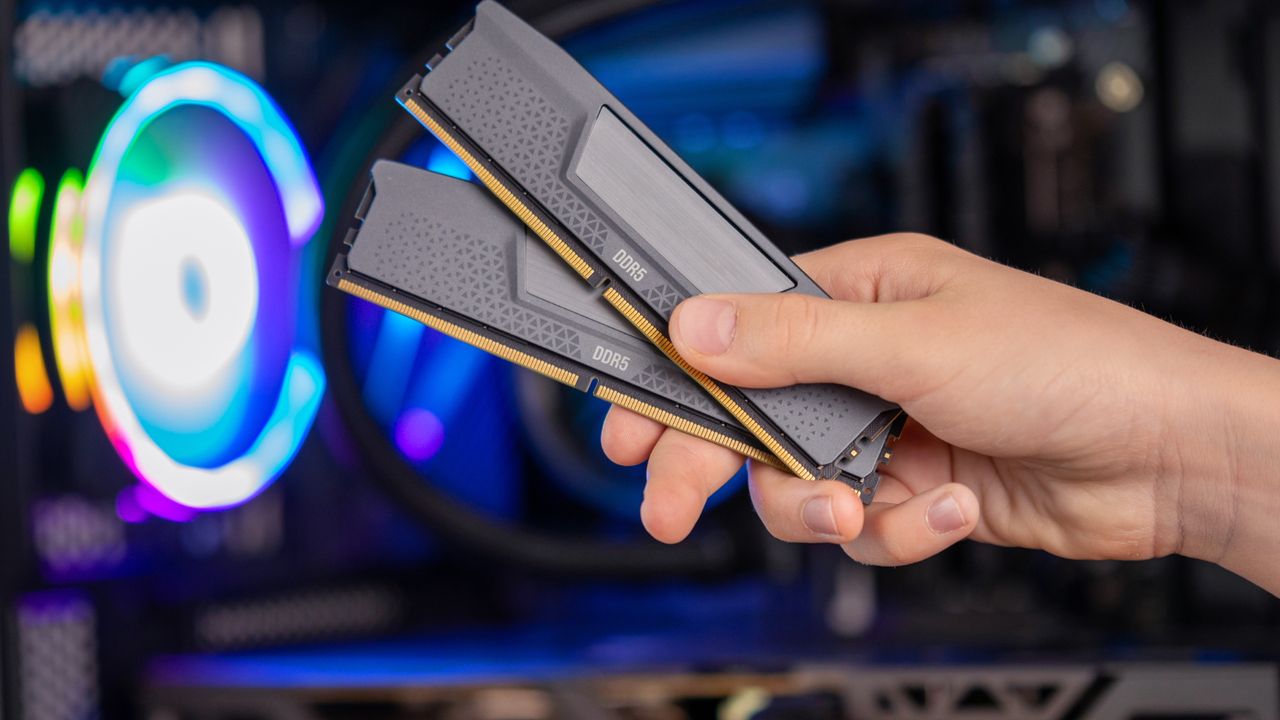
Now modern systems support dual-channel memory by default, with backwards compatibility for a single-channel solution if needed, or if a stick fails. To enable dual-channel, you need to install two individual sticks across two DDR slots in your machine. If you don't, your system will effectively be running single-channel only. For context, two sticks of 16GB DDR5 running at 5,600 MT/s will net you around 89.6 GB/s of theoretical max bandwidth. A single 32GB DDR5 stick running at that same speed halves that at 44.8 GB/s. That's a staggering drop.
Boosting your bandwidth
The issue is that when you have two pieces of hardware vying for the same memory, both trying to utilize that bandwidth (or the highway in our analogy) at the same time, inevitably, you're going to hit a bottleneck where data cannot be transferred fast enough across those channels. And as a result, it slows the entire system down.
In fact, it can be such a huge bottleneck that it can stifle iGPU performance and even some computational tasks by well up to 40% and above. That's average fps, time taken to render a file, compression speed. So many mission-critical applications and use-cases, just hammered by a manufacturer choosing to opt for a single-channel solution instead of dual-channel.
I've seen this too. Earlier this year, I was benchmarking two small iGPU-based gaming PCs, both with a Radeon 890M GPU, one dual channel, one single channel, and both with near-to-identical CPUs (the single-channel boy actually had a better processor with the Ryzen AI 9 HX 470 versus the dual-channel's AI 9 HX 370).
At 1080p in Cyberpunk 2077, the average fps scores were 22 fps on single-channel and 38 fps on the dual-channel machine. Same preset. Same frequency. Same drivers. The works. At higher frame rates, it got even worse: F1: 24, 86 fps on dual-channel, and 30 fps on the single-channel model. The dual-channel machine, too, was generally slower as well, average and max CPU and GPU frequencies were lower, and power draw and temps were practically identical.
The thing that frustrated me most about that particular situation (ignoring the performance) is that nowhere did the manufacturer in question list that it was a single-channel setup; not on the product page, not in the Amazon listing, or even the specs on the side of the box.
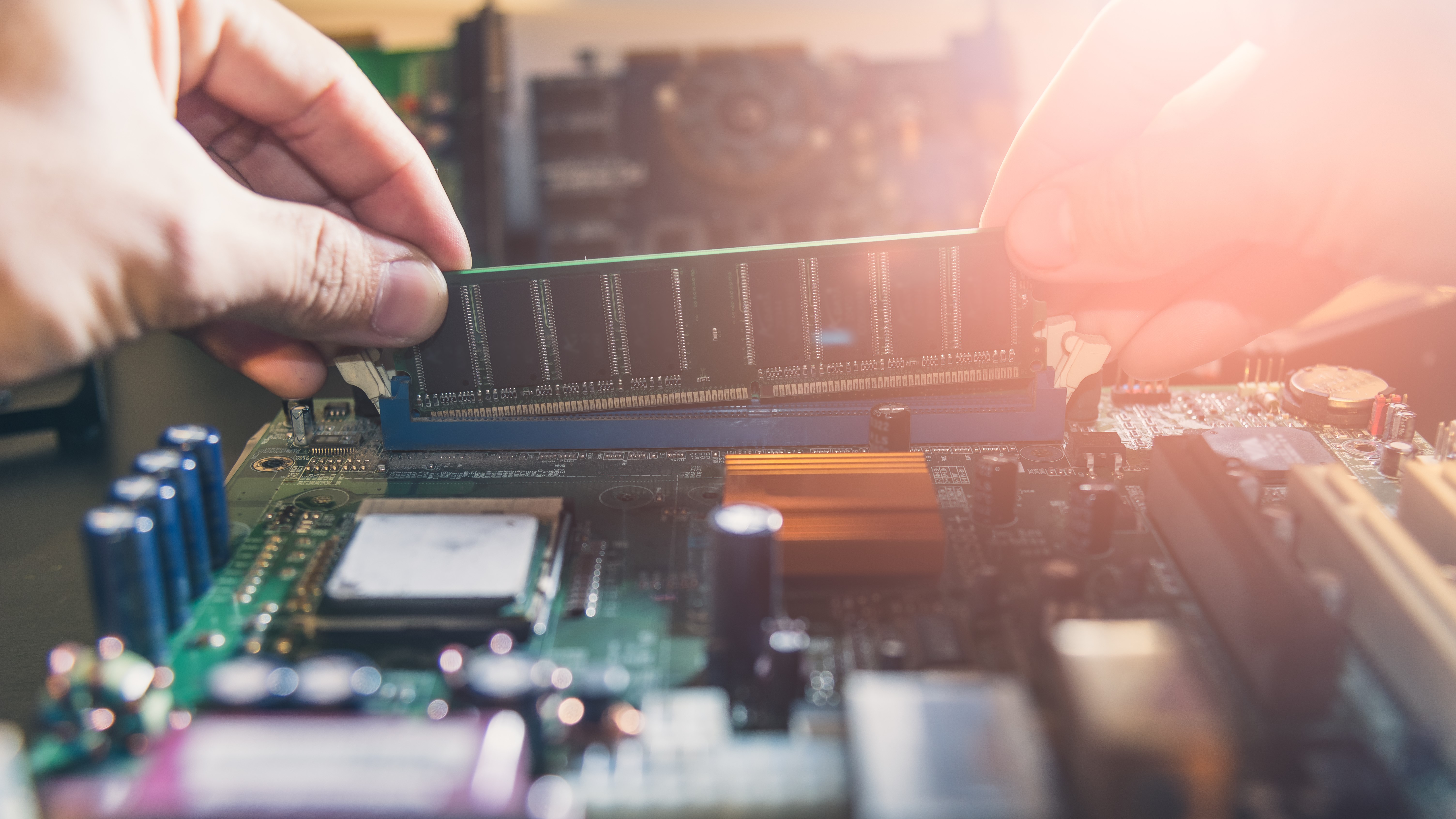
It just had the RAM listed as 32GB and called it a day. Even the big flashy product page with all the features and graphics lit up, had it down as 32GB DDR5, "high speed, expandable, with dual-channel support". Even the 3D renders and the exploded view showed off two DDR sticks. Like seriously, yeah, alright, that's technically all true. You're not lying. Congrats.
This isn't something that's isolated to one-off manufacturers either. I've seen it across big brands and names, and products well into the four-digit categories too. It's just staggering to me.
I get it; memory prices are through the roof, the AI onslaught is moving ever upwards, and memory manufacturers can't keep up with that just yet. But seriously, I can't stress enough just how important it is to do your research right now. To make sure the machine you're potentially considering buying has a dual-channel setup. And if it doesn't and you're reliant on that performance, I'm at the point where I'd genuinely recommend you go buy something else instead.
This is a preview from the original publisher. Continue reading at the source:
Read Full Article on techradar.com →